Title of the work
Country of the First Edition
Country/countries of popularity
Original Language
First Edition Date
First Edition Details
Aleksander Krawczuk, "Alfabet mitologiczny", Magazyn Razem 9 (1985)–3 (1987).
ISBN
Genre
Essays
Myths
Target Audience
Crossover (teenagers, young adults)
Cover
We are still trying to obtain permission for posting the original cover.
Author of the Entry:
Marta Pszczolińska, University of Warsaw, m.pszczolinska@al.uw.edu.pl
Peer-reviewer of the Entry:
Katarzyna Marciniak, University of Warsaw, kamar@al.uw.edu.pl
Elżbieta Olechowska, University of Warsaw, elzbieta.olechowska@gmail.com
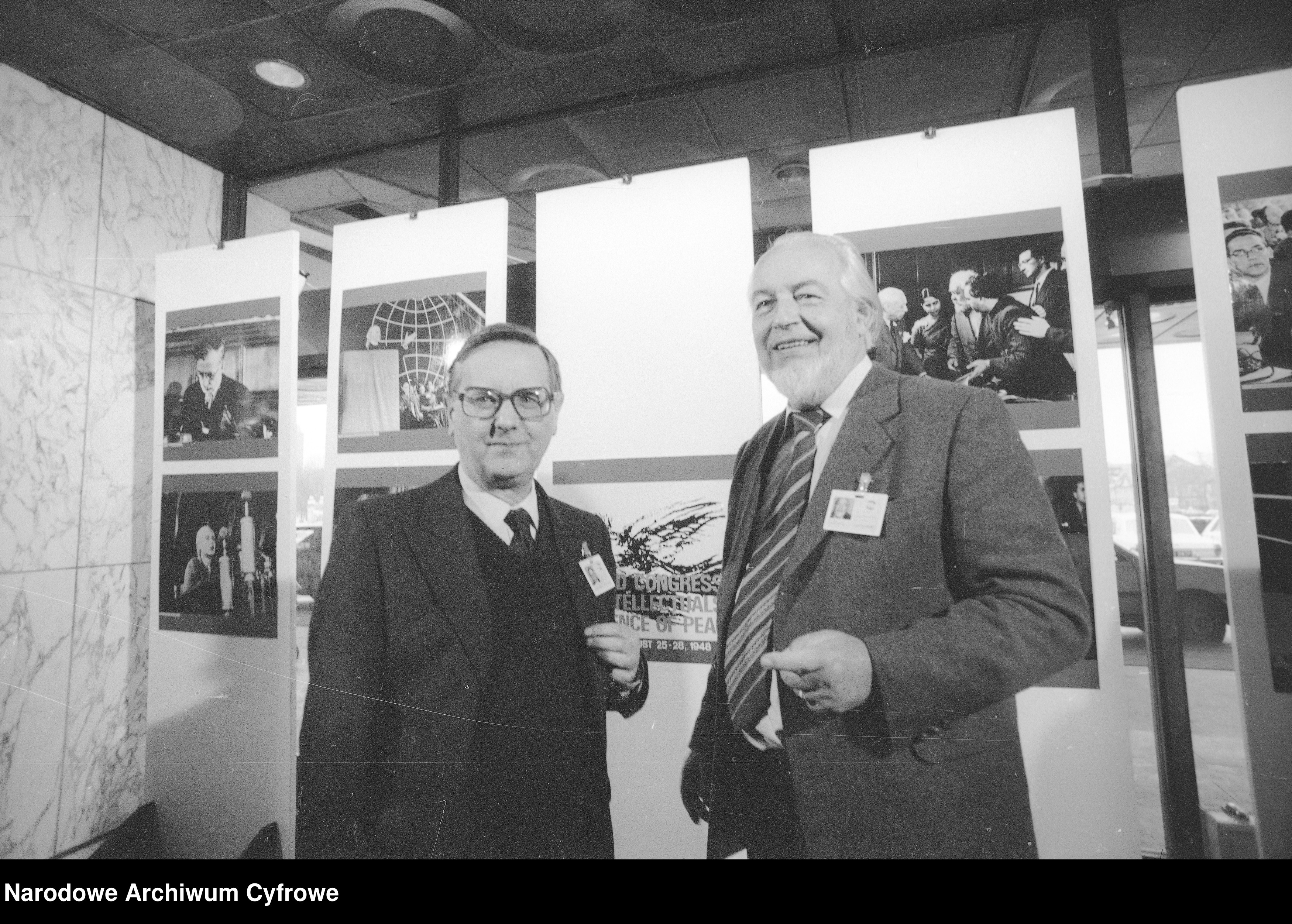
Prof. Aleksander Krawczuk (left) and prof. Hoimar von Ditfurth, German psychiatrist and neurologist, at the Congress of Intellectuals in Defense of a Peaceful Future for the World at the Victoria Hotel in Warsaw, 1986. Narodowe Archiwum Cyfrowe 3/44/0/-/34.
Aleksander Krawczuk
, 1922 - 2023
(Author)
Aleksander Krawczuk (1922–2023) was a Polish ancient historian and classical philologist, writer, keen populariser of classical antiquity, and politician. Born and raised in Kraków, he associated his entire academic career with the Department of Ancient History of the Jagiellonian University, where in 1985 he became a titular professor and head of the department. Besides his scholarly activities, in the early 1960s, he began writing popular books and articles in magazines to increase awareness of Graeco-Roman classics and ancient history in an approachable manner. His aim was to create from historical documents and data books on antiquity that would accurately reflect the past but at the same read like fascinating novels. He confessed in a broadcast that writing articles in accordance with strict scientific methods for a very narrow circle of experts was a not enough. “The thing about history is that it is a living and socially necessary science only when it reaches the widest possible audience. Then it fulfils its role: it shapes thinking and social awareness, stimulates, benefits”.* Some historians did not appreciate this kind of writing, but readers decided quite the opposite. His books became extremely popular in Poland during the communist era, selling out quickly and being republished multiple times; they were also translated into other languages. In the 1970s and 80s, for almost fifteen years, Krawczuk captured television audiences hosting a regular television program on the ancient history and culture Antyczny świat profesora Krawczuka [Professor Krawczuk’s Ancient World]. Owing to his popular publications, TV show and essays on ancient world in historical and cultural weeklies (for example Poczet cesarzy rzymskich [Gallery of Roman Emperors] for the weekly Przekrój), and also to his meetings with the readers and lecture tours across Poland, the professor became a renowned public figure in Poland and the most recognizable historian in the 1980s. In 1986 he became the Minister of Culture and Art in the last Communist governments in Poland and after the fall of Communism he was elected MP of the new democratic parliament twice.
He published over forty books in total. For his scientific achievements, literary works and popularisation of classics, he was awarded prestigious orders and medals, such as the Grand Cross of Polonia Restituta (1997), Gloria Artis Medal for Merit to Culture (2009), and Kowadło Kuźnicy (2013).
* An interview to Edward Miszczak in 1986. Quoted in Michał Czyżewski, “Aleksander Krawczuk: chcę by moje książki o historii dało się czytac jak powieści”, at Polskie Radio website: “Historia ma to do siebie, że wtedy jest nauką żywą i potrzebną społecznie, jeśli dociera do możliwie szerokich rzesz. Wtedy spełnia ona swoją rolę: kształtuje myślenie i świadomość społeczną, pobudza, daje coś”.
Sources:
Elżbieta Olechowska, “Aleksander Krawczuk’s Fascinating Antiquity” in Classics and Class. Greek and Latin Classics and Communism at School, David Movrin and Elżbieta Olechowska, eds., Warsaw–Ljubljana, Faculty of “Artes Liberales”, University of Warsaw, and Znanstvena založba Filozofske fakultete Univerze v Ljubljani (Ljubljana University Press, Faculty of Arts), and Wydawnictwo DiG, 2016, 337–356.
Michał Czyżewski, "Aleksander Krawczuk: chcę, by moje książki o historii dało się czytać jak powieści", Polskie Radio 24 (accessed: March 9, 2026)
"Wspomnienie o profesorze Aleksandrze Krawczuku", Uniwersytet Jagielloński w Krakowie, Archiwum (accessed: March 9, 2026).
Bio prepared by Marta Pszczolińska, University of Warsaw, m.pszczolinska@al.uw.edu.pl
Adaptations
Aleksander Krawczuk, Alfabet Krawczuka mitologiczny, Kraków: Cracovia, 1991, 152 pp.
Summary
Alfabet mitologiczny is a cycle of articles presenting myths, mythical characters and cultural phenomena associated with them, in the form of narrative entries rather than short encyclopaedic ones. The cycle comprises 18 instalments in alphabetical order, as follows:
- A for Adonis, Magazyn Razem (further as MR) 9 1985,
- B for Bellerophon, MR 10 1985,
- C for Centaurs, MR 11 1985,
- D for Danae, MR 12 1985,
- E for Eros, MR 1 1986,
- F for Phaethon, MR 2 1986,
- G for Giants, MR 3 1986,
- H for Hermes, MR 4 1986,
- J for Jason, MR 6 1986,
- K for Cadmus, MR 7 1986,
- L for Leda, MR 8 1986,
- M for Meleager, MR 9 1986,
- N for Niobe, MR 10 1986,
- O for Orpheus, MR 11 1986,
- P for Pan, MR 12 1986,
- R for Romulus, MR 1 1987,
- S for Saturn, MR 2 1987,
- T for Theseus, MR 3 1987.
Analysis
Aleksander Krawczuk was already well known to readers of the monthly magazine Magazyn Razem before he released his Mythologocal Alphabet, having published various texts in the magazine from its very first issue (No. 1, May 1984), namely, a series about history, entitled Magistra vitae, starting with an interview to Wojciech Tatarczuch entitled “Zawinił Sofokles” [Sophocles was to blame], introducing young audiences to Krawczuk’s journey to antiquity when he was their age, his young years during the war and his subsequent academic career, which he considers “available to anyone who is eager to systematically expand their knowledge”.*
Alfabet mitologiczny was the second series of his articles to appear in the monthly magazine. The new cycle was highlighted on the cover by an image of the statue of Adonis and the headline: “Adonis. Prof. Krawczuk begins the Mythological Alphabet with the tale of this beautiful but unhappy young man”. In each instalment, the professor recounts the main myth concerning the title character(s). However, he also introduces additional subplots, minor characters, and their presence in art, literature, music, astronomy, botany, as well as phrases and terms that have entered everyday language. Krawczuk chose mythological narration as the leading theme and an axis of the text, adding subplots, secondary characters, names, alternative versions of the myths, digressions and explanations of difficult terms as if they were a natural part of the narrative. Interestingly, when presenting the mythical tales, the professor does not avoid quoting ancient sources; most frequently, he uses Ovid, but also Simonides of Ceos, Virgil, and Lucian of Samosata. This allows antiquity to speak for itself through the voices of its eminent representatives, while also revealing the beauty of ancient poetry and familiarising readers with the originals. Additionally, modern poetry referencing mythical characters by William Shakespeare and Konstanty Ildefons Gałczyński is quoted.
Alongside presenting ancient sources, Krawczuk describes the cultural phenomena of a particular myth in both ancient and modern cultures, including the Polish context. This allows Polish students to benefit more from the reading material. The author relates old eras and periods to the present and displays them as one continuous tradition and a long chain of reception. He demonstrates to the reader the constant presence of the ancient myths in culture and the importance of knowing them in the contemporary world.
While Krawczuk’s Alphabet ends at the letter T, the 18 entries are sufficient to demonstrate an impressive web of mutual connections between various myths and mythical characters, easily creating a “who's who” of mythology. His 18 stories mention and describe gods, heroes and other mythical and legendary characters, as well as introduce ancient artists and writers – enough material for an entire textbook.
Krawczuk presents (the enumertion here in alphabetical order): Achilles, Acrisius, Actaeon, Admetus, Adonis, Aegeus, Aeneas, Aeëtes, Aethra, Aeschylus, Agamemnon, Agave, Althaea, Amazons, Amor, Amphion and Zetos, Amulius, Antiope (Amazon), Aphrodite, Apollo, Apuleius, Ares, Argonauts, Argus (of Argo), Argus (Panoptes), Ariadne, Artemis, Asclepius, Atalanta, Athena, Atlas, Autonoë, Bellerophon, Cadmus, Calydonian boar hunt, centaurs, Cheiron, Chimaera, Chrysaor, Cleopatra (wife of Meleager), Clytemnestra, Creusa/Glauce, Cronus, Cupid, Danaë, Deianeira, Demeter, Dictys, Dione, Dionysus, Dioscuri, Echidna, Echo, Eros, Eurydice, Euripides, Gaea, Giants, Gigantomachia, Glaucus (water deity), Gorgons, Hades, Harmonia, Harpies, Helen of Sparta, Hestia, Heliades, Helios, Hephaestus, Hera, Heracles, Hermaphrodite, Hermes, Hippolytus, Homer, Hylas, Ino, Iobates, Iris, Iulus/Ascanius, Ixion, Janus, Jason, Laius, Lapiths, Lavinia, Leda, Leto, Lycomedes of Scyros, Maia, Mars, Medea, Medusa, Meleager, Menelaus, Mercury, Minos, Minotaur, Moirai, Myrrha, Nemesis, Nessus, Niobe, Odysseus, Oedipus, Oeneus, Orpheus, Ovid, Pan, Paris, Pegasus, Peleus, Pelias, Pelops, Penelope, Penteus, Persephone, Perseus, Phaedra, Phaethon, Phoebus, Phoenix (son of Agenor), Phrixus, Pirithous, Plato, Polydectes, Polydorus, Poseidon, Priam, Proetus, Prometheus, Psyche, Remus, Rhea Silvia, Romulus, Sabines, Salmacis, satyrs, Scopas, Semele, Silvanus, sirens, Sisyphus, Stheneboea, Socrates, Sophocles, Symplegades, Syrinx, Tantalus, Theseus, Titans, Tyndareus, Typhon, Uranus, Venus, Zephyrus, Zeus.
In 1991, the cycle was adapted and published as a book in the professor’s native city of Kraków, entitled Alfabet Krawczuka mitologiczny [Krawczuk’s Mythological Alphabet]. It was illustrated by Szymon Kobyliński (1927–2002), a famous graphic artist, satirist, and writer.
* Aleksander Krawczuk, „Zawinił Sofokles”, Magazyn Razem 1 (1984): 10.
Further Reading
Olechowska, Elżbieta, “Aleksander Krawczuk’s Fascinating Antiquity” in Classics and Class. Greek and Latin Classics and Communism at School, David Movrin and Elżbieta Olechowska, eds., Warsaw–Ljubljana: Faculty of “Artes Liberales”, University of Warsaw, and Znanstvena založba Filozofske fakultete Univerze v Ljubljani (Ljubljana University Press, Faculty of Arts), and Wydawnictwo DiG, 2016, 337–356.
Addenda
The entry presents the result of research conducted within the project “Classical Antiquity in Periodicals for Children and Young Adults in Polish People’s Republic (PRL) – Classical Education, Promotion of Political Ideology, or Expression of Resistance? Changes in the Reception of Classics in the PRL from 1945 to 1989,” funded by the National Science Centre (Narodowe Centrum Nauki) Preludium grant no. 2022/45/N/HS2/00549, and led by Marta Pszczolińska at the Faculty of “Artes Liberales” at the University of Warsaw.